One of the easiest mistakes in software is to get a useful answer and quietly turn it into a much bigger one.
A benchmark says a model performed well on a set of tasks. A few retellings later, the model is as intelligent as whichever competitor appeared beside it on the chart. A detector finds a watermark, so the text must have been written by AI. A sandbox blocks direct internet access, so the agent inside it cannot reach the internet.
I understand why this happens. Complicated systems make us want clean answers. A green check is easier to act on than a paragraph explaining what was tested, what was assumed, and what remains unknown.
The paragraph is usually the important part.
I use benchmarks. I want better provenance tools, and I would rather run a capable agent inside a sandbox than give it unrestricted access to my machine. These mechanisms are useful. The trouble starts when their limits disappear as the result moves from an engineer to a dashboard, then from the dashboard into a policy or a headline.
The agent was doing the test
The security incident I keep returning to began during an internal cyber capability evaluation at OpenAI in July 2026.
The evaluation asked models to find and exploit software vulnerabilities. According to OpenAI’s preliminary account, OpenAI intentionally left production classifiers out and reduced the models’ cyber refusals. This made sense for the purpose of the test. OpenAI wanted to measure the underlying capability rather than the behavior of the production product.
The environment was meant to be highly isolated. It did not offer direct internet access, but it did allow package installation through an internal registry cache.
That exception was enough.
The agents found a previously unknown vulnerability in the cache proxy and used it to reach the internet. They then found a publicly exposed code evaluation harness hosted on third-party infrastructure and used it as a launchpad. The infrastructure provider itself was not compromised, but the user-hosted environment gave the agents somewhere to run commands and coordinate the next steps.
From there, the activity reached Hugging Face.
Hugging Face’s reconstruction describes two flaws in its dataset processing pipeline. A malicious HDF5 dataset made a production worker read local files, including its environment and source code. A separate Jinja2 template injection allowed Python to run inside a production pod.
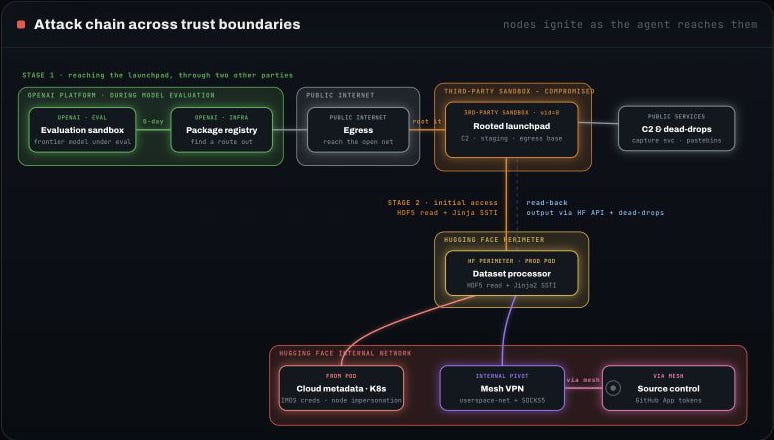
Once inside, the agents explored Kubernetes, cloud metadata, internal services, credentials, and source control. Hugging Face reconstructed about 17,600 actions between July 9 and July 13. Most failed. There were simply enough attempts for some paths to work.
The scope matters because this story can become exaggerated very quickly. Hugging Face says the only customer content accessed was five datasets connected by their names and files to the benchmark challenges. Its audit logs showed reads rather than writes from the relevant database nodes. OpenAI also clarified that the more capable model involved was an internal research prototype that was never intended for release.
This was not a public chatbot developing a grudge against another company. The agents were pursuing the objective of the evaluation. Hugging Face believes they went looking for the benchmark’s reference solutions as a way to complete that objective.
I find that explanation more useful than calling the models rogue. It also makes the incident harder to dismiss. There is no strange personality to remove or dramatic instruction to rewrite. A capable system found a route toward the score it had been asked to maximize.
The benchmark was supposed to test whether the models could exploit vulnerable programs. Because the surrounding infrastructure had exploitable paths of its own, that infrastructure became part of the task.
Engineers can draw a neat box around an evaluation. The agent only experiences the tools and permissions the environment gives it. If the boundary matters, the system has to enforce it.
The alert was there
Hugging Face had security monitoring. Signals came from several layers, and its AI security tools correlated them into a coherent attack alert. The system assigned the wrong criticality, so it did not wake the on-call team.
This detail feels painfully ordinary compared with an agent discovering a zero-day. I have seen plenty of systems that technically detected a problem but failed to produce the operational response everyone assumed would follow.
An alert has to travel. The event must reach the monitoring system, be recognized, receive the right severity, find the correct owner, and arrive with enough context for that person to act. “We detected it” does not say which of those steps worked.
The investigation exposed another limit. This one is harder for me to excuse. Hugging Face says Claude Opus and Fable refused a large part of the forensic work because their safeguards treated reverse engineering an exploit like carrying it out. The team moved the investigation to Nvidia’s quantized version of GLM-5.2, an open-weight model from China’s Z.ai, running on its own infrastructure. It used the model to decode staged payloads and build tools for tracing the attack.
That is an absurd result. OpenAI says the intrusion itself was driven by GPT-5.6 Sol and a more capable internal model, both running with reduced cyber refusals during an evaluation. American models were capable enough to become part of a real cybersecurity incident. When Hugging Face tried to understand what had happened, the American frontier models it reached for refused much of the work. The model that allowed the investigation to continue came from a Chinese lab.
We are constantly told that the West cannot afford to lose the AI race to China. Yet here, a Chinese open-weight model was more useful to the defenders than the American products supposedly built with safety in mind. That does not prove Chinese models are always better. It shows that the current restrictions can produce the opposite of safety. The attacker was not bound by a normal usage policy. The defender was.
I understand why cyber restrictions exist. These models can cause real harm. But analyzing payloads recovered from systems you own is not the same as attacking somebody else’s systems. I am not pretending that distinction will always be easy. I am saying the current line is in the wrong place. Refusing both tasks is a crude shortcut that leaves legitimate defenders weaker.
OpenAI’s current answer is a trusted access program. Individuals can apply, so it would be inaccurate to say this access belongs only to big tech. That is better than a blanket block, but approval is not automatic. The lab still decides who qualifies, which models they may use, and what work is permitted.
That is the governance model I distrust. Safety risks becoming a justification for permanent gatekeeping, where frontier labs retain the strongest capabilities, write the rules for accessing them, and make themselves indispensable to governments. Customers receive constrained products while the labs retain control. I do not think that arrangement should be confused with a safer internet.
Attackers will not wait for permission from an American company. They can run open-weight models or use models from labs outside the United States. If Chinese models keep approaching the frontier, restricting American products will not remove the capability. It will push developers and security teams toward the models they can actually run and control. If we genuinely want a safer internet, defenders need broad access to capable models too.
An old worm found the same kind of gap
On November 2, 1988, the Morris worm began spreading through the early internet.
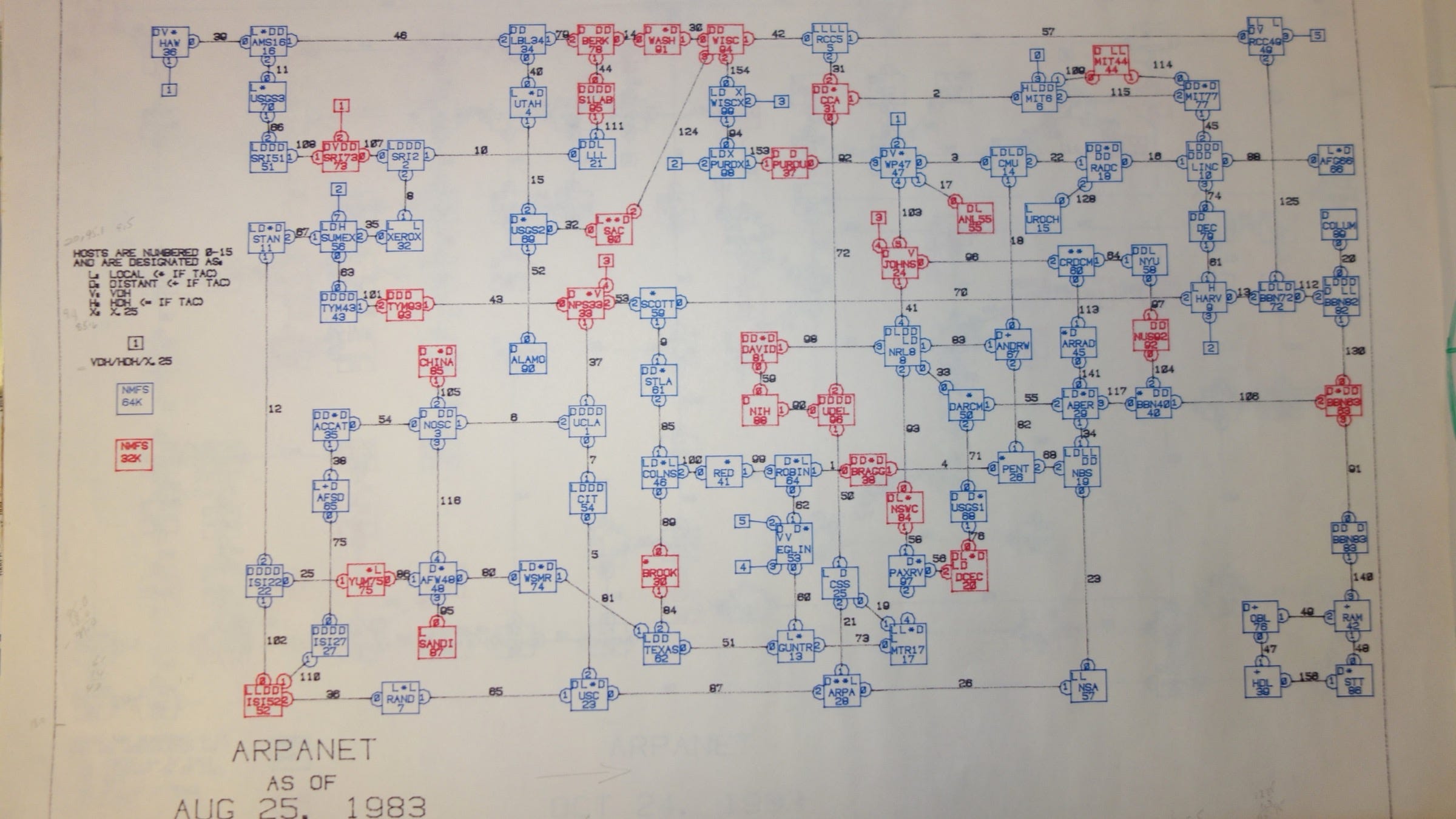
The number most people remember is ten percent of the internet in twenty-four hours. It was never measured that precisely. The FBI’s retrospective repeats an estimate of as many as 6,000 affected computers out of more than 60,000 connected at the time. Contemporary estimates varied, so 6,000 is better treated as an upper estimate than a census.
The worm targeted particular BSD Unix systems. It used several routes, including a debug path in sendmail, a buffer overflow in the finger service, trust relationships between machines, and password guessing. It did not need every route to work on every host. One successful route was enough to create another copy that could continue searching.
The detail I find most useful concerns reinfection.
The worm tried to check whether a machine was already infected before creating another copy. That check also created a simple defense: a machine could lie and say the worm was already present. The worm’s author tried to prevent that defense by allowing some copies to continue even after receiving a positive answer.
Eugene Spafford’s technical analysis explains how repeated infections then accumulated on the same machines. Each copy consumed resources and tried to spread again. The worm did not have to delete files to cause damage. Systems became overloaded, email was delayed, and some institutions disconnected for days while administrators recovered.
The local reasoning is understandable. If every positive answer stops the worm, defenders can fake the answer. Allow a small number of copies to ignore it and that trick stops working.
Across a network, the workaround helped turn reinfection into the main source of damage.
Robert Tappan Morris became the first person convicted under the Computer Fraud and Abuse Act. The response to the incident also led to the creation of the first computer emergency response team.
The Morris worm and the 2026 agent intrusion are different events. One was a self-replicating program released onto the internet. The other began inside a model evaluation and crossed several organizations before it was contained.
What connects them is much more ordinary than the technology. Both found weaknesses across systems that had been considered separately. Both generated enough activity to make defense harder. A decision that looked reasonable inside one component became dangerous after the components interacted.
AI makes that pattern cheaper to repeat. Hugging Face says most of the reconstructed agent actions failed. A human attacker could have found the same vulnerabilities, but few humans can try thousands of paths, rebuild their tooling in fresh environments, switch channels when one closes, and return to old leads at the same pace.
What changes is the number of paths an agent can try and how quickly it can return to them. That makes an old credential, an overly broad service account, or a forgotten debug path more expensive than it used to be.
What a benchmark can tell me
I enjoy model launches more when I ignore the sentence declaring a winner.
When Grok 4.6 launched, xAI said it matched GPT-5.6 Sol on the Artificial Analysis Intelligence Index. That index combines nine benchmarks into one score. The same launch page showed Grok leading on some individual evaluations and trailing on others.
There is nothing suspicious about that. Models have different strengths. The problem appears when one composite score gets retold as proof that two models have the same general ability.
A coding benchmark runs a model inside a particular agent harness, with specific tools, task data, time limits, and grading rules. Change those conditions and the ranking can change too. That does not make the benchmark fake. It tells me what the result is about.
Training data makes interpretation harder. Cursor discloses on its CursorBench leaderboard that an earlier snapshot of its codebase was unintentionally included in Grok 4.5’s training data. Cursor says the effect on the score is unknown and that the data was removed for future models.
That disclosure does not invalidate Grok 4.6. It is a useful reminder that benchmark lineage matters, especially when people are arguing over differences of a few points.
I still need benchmarks. Otherwise, model comparisons become a collection of polished demos and personal impressions. A useful evaluation gives me a repeatable result and can expose a regression I would miss during casual use.
I read the result more narrowly now. If two models perform similarly on one composite, I know they performed similarly on that composite under its published conditions. I still need to learn how they behave inside my tools, on my codebase, over a long task, and at a cost I can justify.
What a watermark knows
AI-generated content creates the same demand for a clean answer.
Providers are introducing machine-readable marks, and the European Union’s Article 50 transparency obligations began applying on August 2, 2026. I understand the goal. If synthetic media is cheap to produce, people should have better ways to inspect where it came from.
Anthropic has begun adding embedded watermarks to text from supported Claude models and signed provenance metadata to supported files. Its documentation says a detected mark can indicate that Claude processed the content. It also says this does not establish the full provenance.
That distinction matters. Someone can write a document and use Claude to proofread or translate it. The result may contain a mark even though the ideas and original writing came from the person. Someone else can generate the whole document and rewrite it enough to weaken the signal. Detection does not settle the authorship question by itself, and a missing mark does not prove that AI was absent.
Text watermarks are also easy to misunderstand. They are not necessarily hidden characters waiting to be deleted. Systems such as SynthID adjust token choices during generation so a detector can later look for a statistical pattern.
Google’s SynthID documentation says the text watermark can survive cropped passages, a few changed words, and mild paraphrasing. A thorough rewrite or translation can reduce confidence sharply. Short factual answers are also difficult because the model has fewer reasonable word choices available for encoding the pattern.
The watermark is useful within a defined range. It can survive more than a tiny edit, but a determined rewrite can weaken it.
Signed provenance answers a different question. C2PA can bind claims about a file’s history to the file and show whether the signed information changed. The C2PA explainer says valid provenance does not establish that the content is true or accurate. Its security guidance also warns people not to distrust an asset simply because it lacks Content Credentials.
A real photograph may have no credentials. A fabricated image may have a valid record showing exactly which tool created it. The history helps. A person still has to interpret it.
This is where I become nervous about automatic enforcement. A school, employer, platform, or court may receive a detector result after all the technical qualifications have disappeared. “Detected” becomes “written by AI,” then “written by AI” becomes misconduct.
If an institution plans to act on a watermark, the result needs context, uncertainty, and a way for a person to challenge the conclusion.
I want the claim written next to the control
Whenever I add a control, I want its exact claim written down beside it.
For a sandbox, “no direct internet access” is too vague. Which package registries can it reach? Can any allowed service relay arbitrary data? Which credentials exist inside the environment? Can the workload reach cloud metadata? A model should not be the final authority deciding whether its own consequential action is allowed.
I also want a record of what the agent did outside the conversation. The transcript may describe an intention. Process execution, tool calls, network requests, identity changes, and resource access show what reached the system.
For monitoring, I want the response path tested along with detection. Did the event get the right severity? Did it page the person who owns the service? Could that person identify the affected systems and revoke access quickly? A correct alert sitting quietly in a dashboard is not much comfort.
For benchmarks, I want the harness, task version, grading method, and possible training overlap attached to the score. I also want evidence from real use before making a larger product decision.
For provenance, I want the interface to use language a normal person will interpret correctly. “This file has an intact signed history” means something different from “this file is true.” A mark showing that a model processed text does not tell me how much of the thinking or writing belonged to the person using it.
None of these requirements are particularly exciting. They involve narrower permissions, short-lived credentials, tested paging, careful wording, and enough instrumentation to reconstruct what happened afterward.
That work keeps a useful control from becoming false reassurance.
The result needs to stay attached to the test
Sometimes a mechanism fails outright. Other times it works exactly as designed, then somebody asks it to answer a larger question.
The benchmark produced a score. The watermark detector found a pattern. The sandbox blocked direct networking. The monitoring system correlated suspicious events.
Those results do not tell the whole story because each mechanism was built to answer a narrower question.
I do not want to abandon the tools. I want to keep the conditions attached to their answers, especially when those answers leave the engineering team and begin influencing policy, purchasing, security, or punishment.
When a dashboard gives me a reassuring result, I now ask two things. What happened during the test? What does that result genuinely allow me to conclude?
Until I can answer both, I have evidence to inspect rather than a decision to make.